Engravings of the year 1618


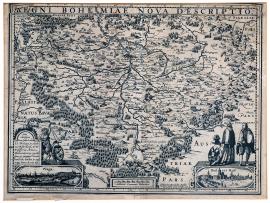
A new description of the Czech kingdom
It is a detailed, but sometimes inaccurately elaborated, map of the Czech countries, furnished with a scale on its edges. At the right bottom corner are depicted Hradčany outside which is a person wearing a coat and holding a string with the tied imperial eagle. Not far away is a person making a bow and taking off his hat. On the other side in a decorative cartouche there is the symbol with the Czech lion held by a faun leaning against the board on which there is the dedication to Eylhar Lubina, professor at the university in Rostock, from the engraver Kaeria.
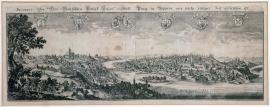
The prospect of the very well-known and famous royal capital city of Prague in Bohemia, as it looks now.
The view of the entire city of Prague across both banks of the Vltava („Moltav fluvius“) has been drawn very carefully. In the left foreground there is a staffage of trees. Above the picture there is the above-mentioned text. In the sky there are coats of arms: Hradčany, Malá Strana (Little Quarter), Czech, Imperial, Staré Město (Old Town), Nové Město (New Town) and Vyšehrad. The print is not signed, but the concept is reminiscent of Hollar, or perhaps the graphic art was based on Hollar's template. This engraving is in many ways strikingly similar to Hollar's picture of Prague.
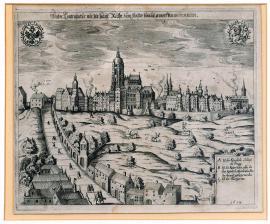
An actual picture of the emperor’s counsels being thrown out of the window.
It is a picture of Hradčany from the today’s Klárov. On the left side there are the new castle stairs. In the place of the today’s gardens on the slope to the Lesser Town there is a preserve (“Thiergarten”) with the deer. Under B there is the provincial office window from which the emperor’s governors are falling. At the upper corners there are the imperial eagle and the Czech lion in laurel wreaths. At the right bottom corner is legend A-C; there is an explanatory inscription in German over the picture.
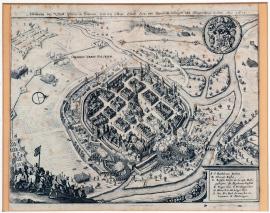
A picture of the town of Pilsen in Bohemia, which was besieged and conquered by the general Mansfeld in 1618.
The picture of Pilsen is painted from a bird’s eye view with accurate details of various buildings. The attack of general Mansfeld’s armed forces is targeted at the Franciscan church. At the right upper corner is the emblem of the town of Pilsen in a decorated field. On the same side down there is legend A-I in a four-edge cartouche. On the left side down there are two riders, of whom one is holding a flag, and a few infantrymen. At the left upper corner is the inscription “Obsidio urbis Pilsenae”.
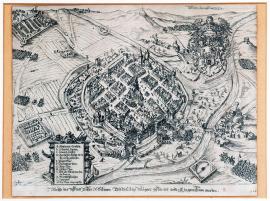
A drawing of Pilsen in Bohemia, which was besieged and conquered by the attack.
The town of Pilsen is drawn with good prospects. From the west, Mansfeld’s army is getting into the town through the ruptures in the town walls. At the left upper corner there is a camp of Mansfeld’s army. On the right up there is the emblem of Pilsen and down is the Radbuza river and the orienteering compass. At the left bottom corner there is a decorative cartouche with legend A-M.